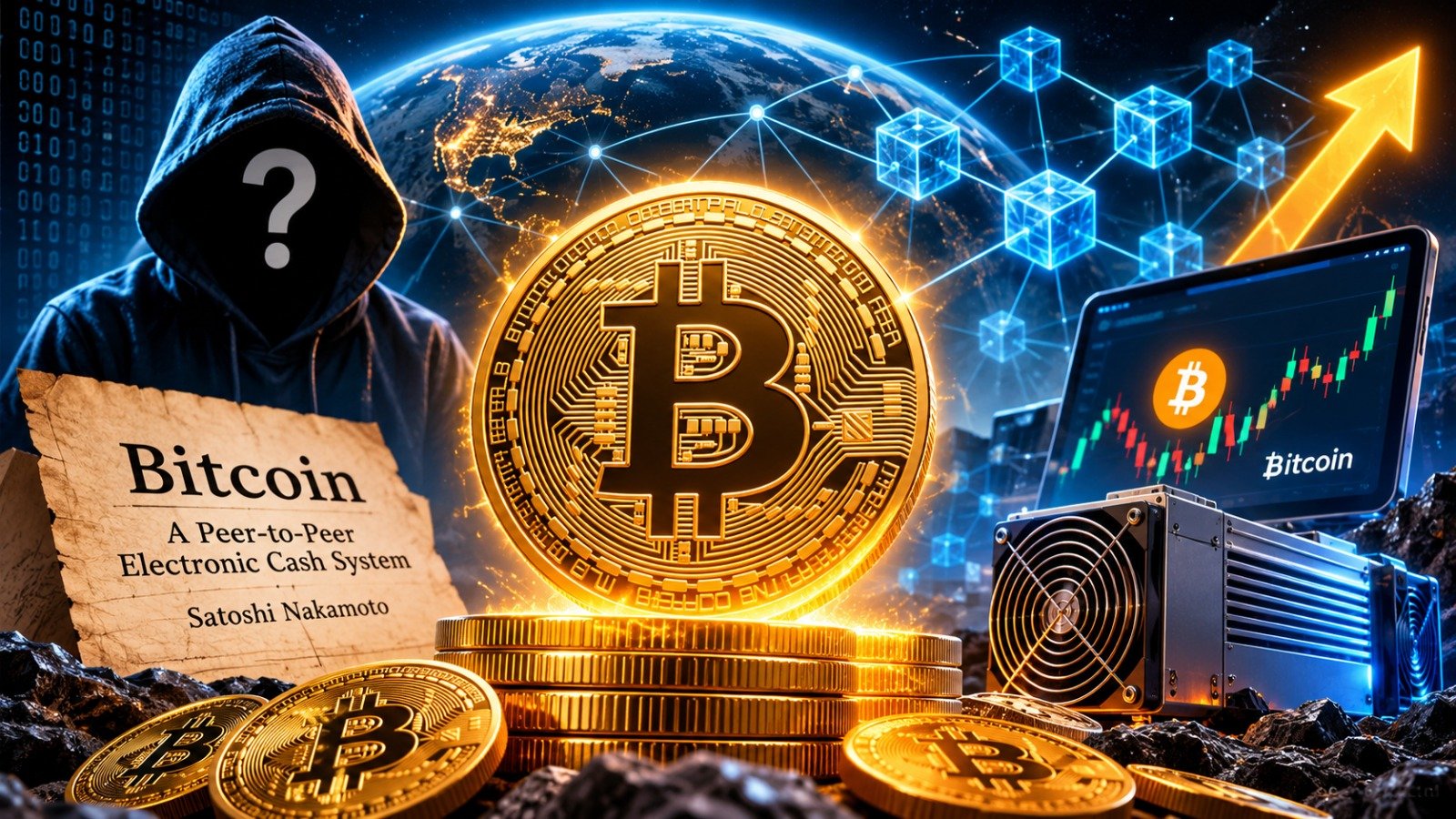
Introduction: The Digital Revolution That Changed Money
What if money could exist without a bank, operate across international borders, and allow people to transfer value directly to one another? This idea once sounded impossible, but Bitcoin turned it into reality.
Bitcoin is one of the most important innovations in modern financial technology. Introduced in 2009, it became the first widely adopted decentralized cryptocurrency and opened the door to an entirely new digital financial ecosystem.
Today, Bitcoin is discussed by investors, technology experts, economists, businesses, and governments around the world. Some people view it as digital gold, while others see it as an innovative payment system or a highly risky financial asset.
But what exactly is Bitcoin? Who created it? How does it work? And why has it become so influential?
Let’s explore the technology, history, advantages, risks, and future possibilities of Bitcoin.
1. What Is Bitcoin?
Bitcoin is a decentralized digital currency that allows people to send and receive value over the internet without requiring a central bank to control its network.
Unlike traditional currencies, Bitcoin is not issued by a government or managed by a single financial institution. Instead, it operates through a distributed network of computers that follow a common set of rules.
Bitcoin transactions are recorded on a public blockchain, which acts as a shared digital ledger.
The smallest unit of Bitcoin is called a satoshi. One Bitcoin contains 100 million satoshis, allowing users to transact in very small fractions.
One of Bitcoin’s most important characteristics is its limited supply. Its protocol sets a maximum supply of 21 million bitcoins.
This limited supply is one reason why many people compare Bitcoin to gold.
2. Who Created Bitcoin?
Bitcoin was introduced in 2008 through a document titled “Bitcoin: A Peer-to-Peer Electronic Cash System.”
The document was published under the name Satoshi Nakamoto.
In January 2009, the Bitcoin network officially began operating when its creator mined the first block, known as the Genesis Block.
However, Satoshi Nakamoto’s real-world identity remains unknown.
The introduction of Bitcoin came shortly after the global financial crisis of 2007–2008, a period when public confidence in traditional financial institutions faced serious challenges.
Bitcoin offered a different financial model based on cryptography, decentralized verification, and a transparent transaction record.
Satoshi Nakamoto eventually stopped communicating publicly, leaving the Bitcoin network to continue operating through its global community of developers, miners, businesses, and users.
3. How Does Bitcoin Work?
Bitcoin works through a decentralized network of computers that maintain and verify transaction records.
The technology behind Bitcoin combines cryptography, blockchain, and a consensus mechanism called Proof of Work.
Here is how a typical Bitcoin transaction works:
Step 1: Creating a Transaction
A user opens a Bitcoin wallet and enters the recipient’s Bitcoin address and the amount they want to send.
Step 2: Digital Signature
The wallet uses the sender’s private key to authorize the transaction digitally.
Step 3: Broadcasting the Transaction
The transaction is shared with the Bitcoin network.
Step 4: Verification
Network participants check whether the transaction follows Bitcoin’s rules, including whether the sender has sufficient available funds.
Step 5: Mining
Miners compete to solve a computational puzzle. The successful miner can add a new block of valid transactions to the blockchain.
Step 6: Confirmation
Once the block is accepted by the network, the transaction receives its first confirmation. Additional blocks provide further confirmations.
This decentralized process allows Bitcoin to operate without a single central authority controlling every transaction.
4. What Is Bitcoin Mining?
Bitcoin mining is the process through which specialized computers compete to add new blocks to the Bitcoin blockchain.
Mining uses a consensus mechanism called Proof of Work.
Miners use computational power to search for a valid solution to a mathematical puzzle. The first miner to find a valid solution can propose a block to the network.
When the block is accepted, the miner receives a block reward consisting of newly issued bitcoins and transaction fees.
Mining serves two important purposes:
- It helps verify and confirm transactions.
- It helps secure the Bitcoin network against certain types of attacks.
However, Bitcoin mining requires significant electricity and specialized hardware. Its environmental impact is therefore an important subject of discussion.
5. Why Does Bitcoin Have a Limited Supply?
Bitcoin has a maximum supply of 21 million coins.
Unlike traditional currencies, whose supply may increase through monetary policy, Bitcoin’s issuance follows rules written into its protocol.
New bitcoins enter circulation through mining rewards.
Approximately every four years, the Bitcoin network experiences an event known as the halving. During this event, the block subsidy paid to miners is reduced by half.
The most recent halving occurred in April 2024, reducing the block subsidy from 6.25 BTC to 3.125 BTC per block.
Halving events gradually reduce the rate at which new bitcoins are created.
The final bitcoin is expected to be mined around the year 2140, although the exact timing depends on block production.
This predictable supply schedule is one of the main features that distinguishes Bitcoin from traditional monetary systems.
6. Major Advantages of Bitcoin
Bitcoin offers several interesting advantages that have attracted global attention.
1. Decentralization
Bitcoin does not depend on one central bank or financial institution to operate its network.
2. Global Transactions
People can send Bitcoin across international borders using compatible wallets and internet access.
3. Limited Supply
The maximum supply of 21 million bitcoins creates a predictable issuance schedule.
4. Transparency
Bitcoin’s public blockchain allows users to inspect transaction history and verify network activity.
5. Financial Innovation
Bitcoin has encouraged the development of cryptocurrency exchanges, digital wallets, payment technologies, and blockchain-related businesses.
6. User Control
People who securely manage their own private keys can directly control their Bitcoin holdings without depending on a custodial service.
However, self-custody also means that users are responsible for protecting their access credentials.
7. Risks and Disadvantages of Bitcoin
Despite its advantages, Bitcoin is not a risk-free financial asset.
Price Volatility
Bitcoin prices can change significantly within hours or days. Investors may experience substantial financial losses.
Security Risks
Although the Bitcoin protocol has strong security properties, exchanges, wallets, and individual accounts can still be compromised.
Lost Private Keys
If someone loses access to their private keys or recovery information, recovering their Bitcoin may be impossible.
Transaction Fees
Bitcoin transaction fees can increase when network demand is high.
Environmental Concerns
Proof of Work mining consumes electricity, raising concerns about energy sources and environmental sustainability.
Regulatory Challenges
Governments have different approaches to Bitcoin ownership, trading, taxation, and payments.
Understanding these risks is essential before buying, holding, or transferring Bitcoin.
8. Bitcoin vs Traditional Money
Bitcoin and traditional currencies have some similarities, but their financial structures are very different.
Traditional currencies are generally issued and managed by central banks and governments. Their supply and monetary policies can change according to economic conditions.
Bitcoin, on the other hand, follows a decentralized protocol with a predetermined maximum supply.
Traditional money is widely used for everyday purchases, salaries, taxes, and business transactions. Bitcoin is primarily used as a digital asset, although it is also accepted for payments by some businesses.
Another important difference is transaction reversibility. Traditional financial institutions may sometimes reverse or investigate certain transactions, while confirmed Bitcoin transactions generally cannot be reversed.
Neither system is perfect. Both have different purposes, advantages, and limitations.
9. The Future of Bitcoin
Bitcoin’s future remains one of the most interesting discussions in financial technology.
Several developments may influence its adoption.
The Lightning Network is a payment layer designed to enable faster and potentially cheaper Bitcoin transactions by processing many payments outside the main blockchain before settling them on-chain.
Institutional participation has also increased through investment products and financial services in certain markets.
Businesses are exploring Bitcoin-related payment infrastructure, while developers continue working on network security and usability.
However, Bitcoin’s future will depend on several factors, including government regulation, technological development, market demand, security, and public trust.
There is no guarantee that Bitcoin’s value will increase or that it will replace traditional currencies.
10. Important Lessons for Bitcoin Beginners
Anyone interested in Bitcoin should begin with education rather than speculation.
Here are some important guidelines:
- Understand Bitcoin’s technology before purchasing it.
- Research cryptocurrency exchanges and their security practices.
- Never share your private keys or recovery phrases.
- Be careful of fake investment schemes and guaranteed-profit promises.
- Understand market volatility before making financial decisions.
- Learn the legal and tax requirements in your country.
- Never invest money you cannot afford to lose.
Knowledge, patience, and responsible decision-making are essential when exploring digital assets.
Conclusion: Bitcoin’s Lasting Impact on the Financial World
Bitcoin has changed the way people discuss money, financial independence, digital ownership, and decentralized technology.
Since its introduction in 2009, it has developed from an experimental digital currency into a globally recognized financial and technological innovation.
Its decentralized structure, limited supply, transparent blockchain, and Proof of Work security model make it fundamentally different from traditional monetary systems.
Nevertheless, Bitcoin also faces important challenges, including price volatility, energy consumption, cybersecurity risks, and regulatory uncertainty.
Whether Bitcoin becomes a major part of the future financial system or remains primarily a specialized digital asset, its influence on financial innovation is already significant.
Final Thought: Bitcoin teaches us that the future of money is not only about how we pay, but also about how we create, protect, transfer, and understand value in a digital world.
Disclaimer: This article is for educational and informational purposes only. It does not constitute financial or investment advice. Cryptocurrency investments involve substantial risks and potential losses.